


I saw a headline this week that made me genuinely angry, and I don’t say that lightly.
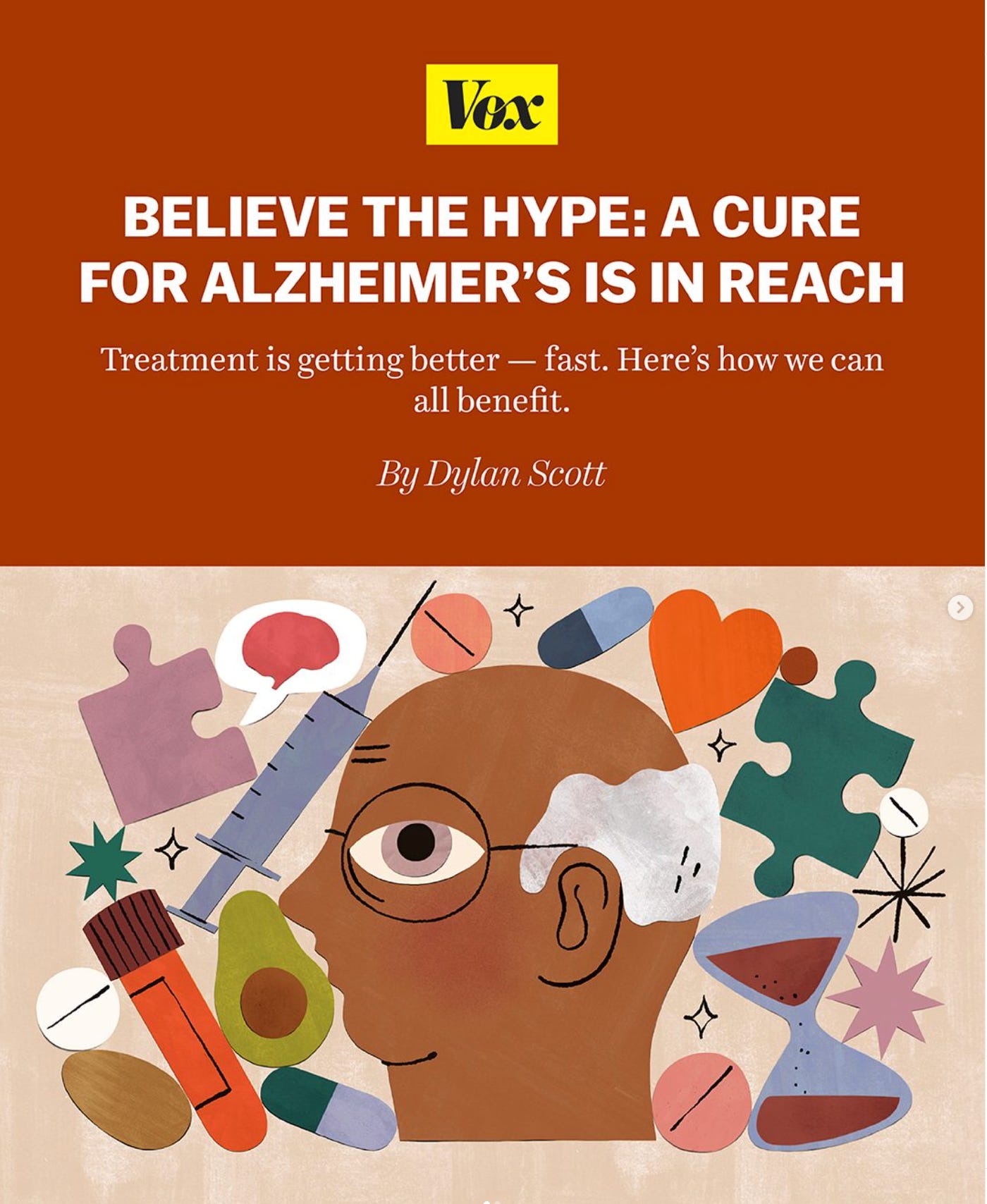
It was one of those big, hopeful, a-corner-has-been-turned Alzheimer’s headlines. The kind that a woman whose mother is slipping away reads on her phone at midnight and feels her chest unclench for a second. The kind that makes a family think, maybe. Maybe there’s something now.

So I paid the two dollars and I read the whole thing. And here’s the strange part. The article itself is more careful than the headline. The reporter quotes the risks. He even notes that hype has outpaced the science before. But almost nobody reads the whole article. They read the headline, they feel the glow of it, and they walk away believing we are closer to a cure than we are. That gap, between what a skimmed headline implies and what the science actually says, is the thing that hurts real people. So let me walk you through what the science actually says.
The story is really about two drugs. Lecanemab and donanemab. You may have seen the brand names, Leqembi and Kisunla. They are, to be fair, real progress, and I won’t take that from them. They are the first drugs that have clearly, definitively slowed the cognitive decline of Alzheimer’s in large trials. For a disease that has humiliated every treatment thrown at it for decades, that matters.
But here is what the headline does not tell you, and what every family deserves to know before their hope gets hijacked.
These drugs do not make anyone better.
Let me be precise, because precision is the whole point here. In the trials, lecanemab slowed decline by about 27% and donanemab by around 35% over eighteen months (van Dyck et al., New England Journal of Medicine, 2023; Sims et al., JAMA, 2023). Read those numbers carefully. They are not percentages of people who improved. They are a slowing of how fast people got worse. Nobody in those trials got their memory back. Nobody stopped declining. They declined a little more slowly. The disease kept winning. It just advanced at a slightly gentler pace.
The most honest line in the entire article came from one of their own experts, who said, in plain words, that you don’t get any better. You’re still getting worse. You just get worse more slowly
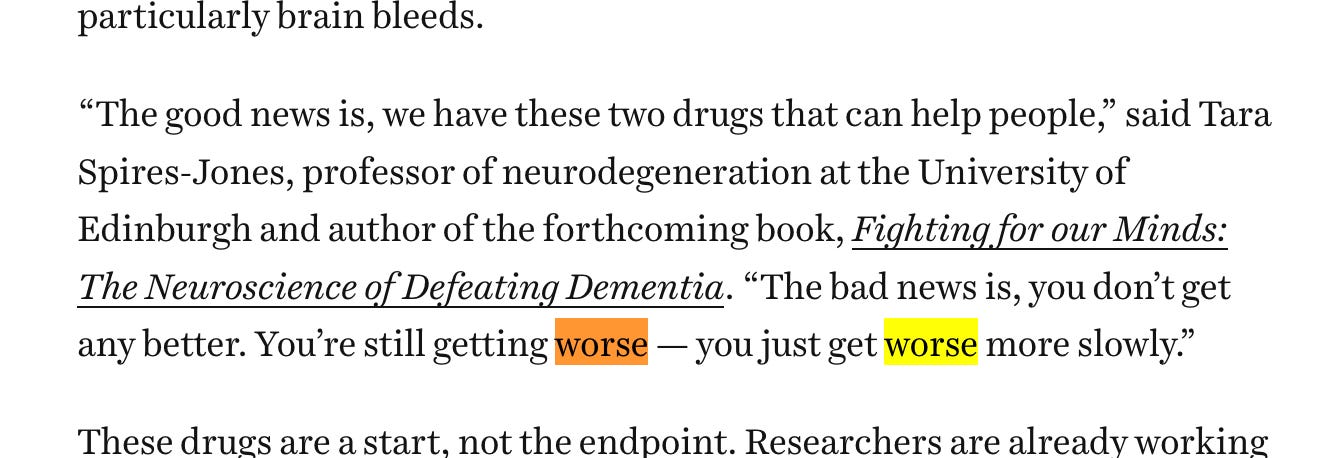
.
My Daily Routine with: Timeline Nutrition
If you’ve been reading my work for a while, you know I don’t think about brain health in isolation. The brain is part of a much larger system, and many of the biological processes that change with age are happening throughout the body.

One of those is mitochondrial health.
Mitochondria are responsible for producing much of the energy our cells need to function. And as we get older, the quality of those mitochondria matters—not just how many we have, but how effectively our cells identify and clear damaged ones.
This is one of the reasons I’ve been interested in Urolithin A, the compound found in Timeline’s Mitopure.
Urolithin A is produced naturally by the gut microbiome from compounds found in foods like pomegranates, but not everyone produces meaningful amounts of it. Mitopure provides Urolithin A directly, and it has been studied in humans for mitochondrial health and muscle function.
I use Mitopure as part of my own routine because when I think about longevity, I’m not only interested in lifespan. I care about maintaining the systems that allow us to remain strong, metabolically healthy and physically capable as we age.
And that matters for the brain too. Exercise, muscle and metabolic health are all pieces of the larger brain-health picture I talk about constantly.
If you want to try Mitopure, you can go to timeline.com/neuro and use code NEURO for the offer available through my link.
I've spent my career on one mission: ending Alzheimer's disease. Most weeks I'm on a plane somewhere, on a stage in front of thousands of people, saying some version of what I'm about to say to you. So when a headline muddies the thing I've given my life to, I take it personally.
Ok so let’s get back into the article….
To be fair to the reporter, he put it in. It’s right there in the article, an expert saying plainly that you don’t get better, you just get worse more slowly. I give him real credit for that. But it sat in the middle of the piece, under a title about “game-changing treatments,” and a title is the only part most people ever read. The honest line was there. It just wasn’t loud enough to survive the scroll.
And it gets heavier, because these are not gentle drugs.
They are IV infusions, given repeatedly over many months. Before you can even start, you need genetic testing and a brain scan. And they carry a risk the acronym makes sound tidy but isn’t: ARIA, which stands for amyloid-related imaging abnormalities, which is a clinical way of saying swelling or bleeding in the brain. In the lecanemab trial, brain swelling or bleeding showed up in around 17% of people, compared with roughly 9% on placebo (van Dyck et al., 2023).
With donanemab, brain swelling appeared in roughly a quarter of patients, and in the trials, a small number of people died from it (Sims et al., 2023)!!!!!

So let me lay out the full picture the headline compressed into the word “BREAKTHROUGH”
Repeated IV infusions. Genetic testing. Ongoing brain scans to catch bleeding you often can’t feel. Enormous cost. Real medical risk, including, rarely, death. All so that someone may decline a little more slowly, for a while, without ever actually getting better.
I want to be fair, because fairness is what I’m demanding from them. This does not make these drugs worthless. For a specific person in the earliest stage of the disease, who understands exactly what they’re signing up for, who weighs the modest benefit against the real risk with a doctor who tells them the truth, these drugs can be a reasonable choice. Progress is progress, and I won’t pretend eighteen months of slightly slower decline means nothing to a family trying to hold on to someone.
But that is a very different story than the one the headline told.
Here is what makes me angry, underneath all of it. By 2050, an estimated 153 million people will be living with dementia (The Lancet Public Health, 2022). That is not an abstraction. That is mothers, fathers, partners, the person who taught you to drive. And those families do not need false hope dressed up as journalism. They need the truth, because the truth is the only thing they can actually plan their lives around.
And the truth is this. We have made real progress. We do not have a cure. And we are not close to one.
Which is exactly why I will not stop saying the unglamorous thing, the thing that doesn’t make a thrilling headline, the thing that is nonetheless the most powerful tool we have right now.
Prevention.
And here’s the part of that same article that nobody turned into a headline, even though it’s the most important sentence in the whole piece. Buried near the end, one of its own experts admits that even a future cure will be conditional, because Alzheimer’s eventually kills the brain, which is why it has, in the article’s own words, a 100 percent fatality rate, and once the disease is too entrenched there may be a point of no return.
Sit with that. Even the optimistic version of the future has a ceiling. There is a point past which no drug, invented or not yet invented, can bring someone back, because the tissue is gone.
Which is the entire argument for doing the unglamorous thing now.
The drugs in that article arrive at the very end of the story, when amyloid has already flooded the brain and the damage is largely done, and the best they can offer is to slow the ending. But the disease begins twenty, thirty years earlier, in silence, while you still feel completely fine. That long quiet window, decades before any headline would apply to you, is where the real leverage is. It is where your blood pressure, your blood sugar, your sleep, your muscle, your hearing, the things I come back to again and again, actually move the needle. Not by slowing an ending, but by changing whether you ever reach the point of no return in the first place.
A drug that helps you decline more slowly is worth having. A life built so the decline starts later, or more gently, or not on schedule, is worth more.
Don’t let a headline sell you an ending when the real power is in the beginning.
And I want to hear from you on this one, because I know I’m not the only one who feels it. If you read that headline and felt a flash of hope, I’m not sorry I took it back.
I’m sorry someone handed it to you falsely in the first place. Has a health headline ever done this to you, promised you something in the title that the article quietly walked back?
Tell me in the comments. I read them.
More soon,
Louisa


